Submersible Pump Service in Wichita
Submersible well pump service in Wichita: pulling, testing, and servicing deep-well pumps, with sizing matched to your well depth and water.
What a submersible pump does and when it needs service
Most deeper wells around Wichita use a submersible pump — a sealed motor-and-pump unit that sits below the water line and pushes water up the drop pipe to your pressure tank. Because it runs underwater and underground, it's out of sight until something changes at the tap, which is why service calls often start with a symptom rather than a visible fault.
Common signs include dropping pressure, sputtering or air in the lines, a motor that short-cycles or runs continuously, higher electric use, or water that suddenly carries more sediment. Any of these can point to a worn pump, a failing motor, a clogged intake screen, or a problem in the wiring that runs down the well.
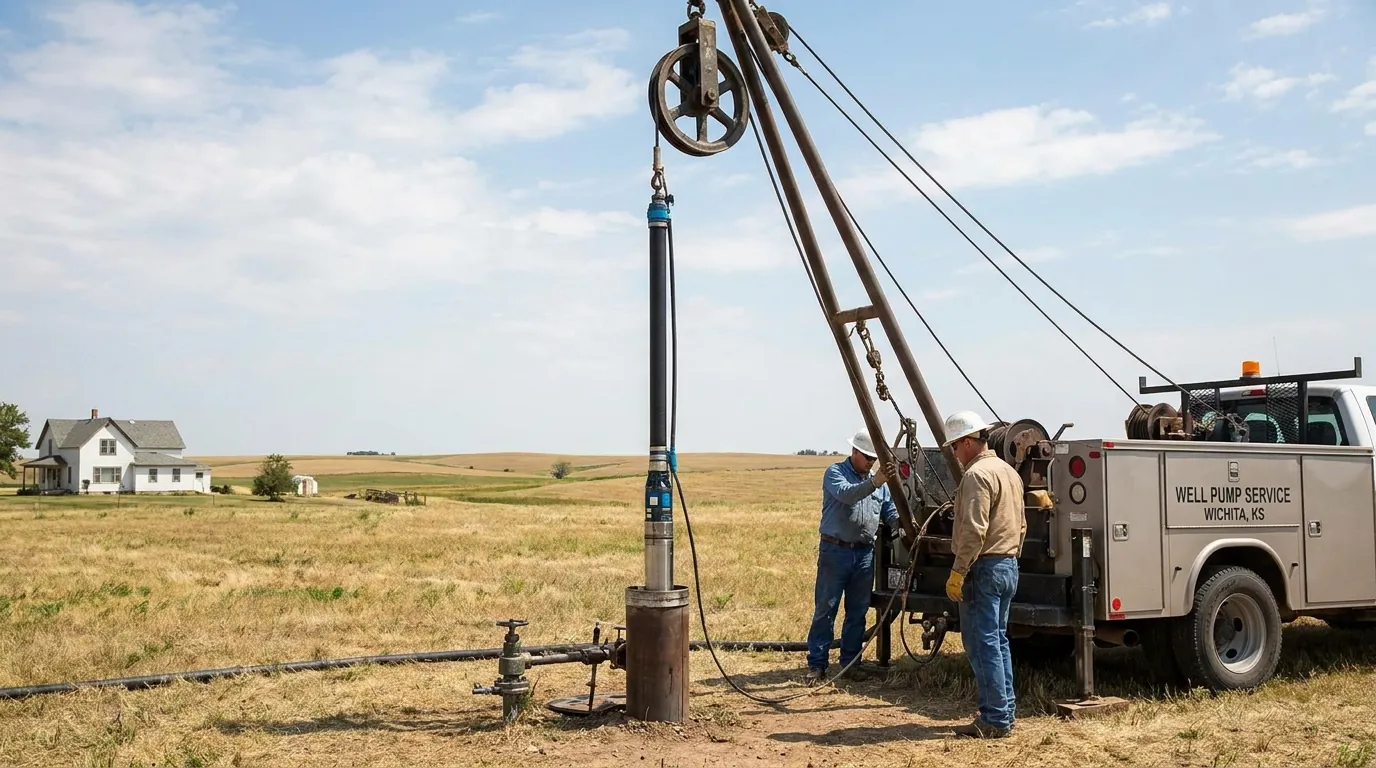
Servicing a submersible unit means pulling it, and that's a job of weight, depth, and careful handling. Below we explain how the work goes and how local conditions shape it. If the unit is still serviceable it ties into well pump repair; when it isn't, it leads to well pump replacement.
How submersible pump service works
Pulling and servicing a deep-well pump follows a careful sequence.
-
Confirm it's the pump
Before anything is pulled, we verify the problem is actually downhole and not the tank, switch, or wiring at the surface. Pulling a pump is real work, so we rule out cheaper causes first.
-
Pull the drop pipe
The pump, drop pipe, and safety line come up together — often a hundred feet or more of pipe and wire. Depth and the condition of the pitless adapter determine how involved this step is.
-
Test the motor and pump
On the surface we check the motor electrically, inspect the intake screen and impellers for wear or scale, and look at the wire and splices for damage from heat cycling or corrosion.
-
Service or replace
Where components are sound, we clean, repair, and reinstall. Where the motor or pump end is worn out, we explain sizing for a replacement matched to your well's depth and yield.
-
Reinstall and verify
The unit goes back down, the wellhead is resealed, and we confirm pressure, amp draw, and cycling are back in a healthy range before we leave.
How well depth and water change the job
Well depth, water-table level, and mineral content vary across the Wichita area, and together they drive how a submersible pump wears and how a replacement should be sized. A pump set too high relative to the water level can draw air during drawdown; one set deeper fights more head pressure. Matching the pump to the actual depth and yield of your well is central to service that holds up.
Hard water and iron, common in local aquifers, build scale on intake screens and impellers and shorten the working life of the pump end. Wide temperature swings and spring storms also stress the wiring and splices that run the length of the well. When we pull a unit, we read the wear against your water conditions rather than assuming every well behaves the same.
If several symptoms are appearing at once and you're unsure whether the pump is even the culprit, a broader well inspection is a sound first step. When pressure alone is the complaint, our low water pressure diagnosis can often pinpoint the cause without pulling anything.
Service your submersible pump the right way
Call to schedule submersible pump service in Wichita — we diagnose first, pull only when needed, and size any replacement to your well.
Covering Wichita, Bel Aire, Park City, Maize, Valley Center, Derby, and Andover.
Frequently asked questions
How do I know if my submersible pump is the problem?
Dropping pressure, air or sputtering at the taps, constant running, or new sediment can all point downhole — but so can tank and switch faults at the surface. We test the surface equipment first and only pull the pump when the evidence points that way.
How deep does a submersible pump sit?
It depends on the well. In the Wichita area depths vary by neighborhood and town, and the pump is set below the water line, often a hundred feet or more down. That depth is a major factor in how the service work goes.
Can a submersible pump be repaired, or does it need replacing?
It depends on what's worn. A clogged screen, damaged wire, or minor issue can often be serviced, while a burned-out motor or heavily scaled pump end usually calls for replacement. We inspect the pulled unit and explain the options before you decide.
Why does my water have sediment after years of being clear?
New sediment can signal a worn intake screen, a dropping water table pulling from a different zone, or scale breaking loose inside the system. Pulling and inspecting the pump, along with checking the well, tells us which it is.